

The Constitutional Substrate
for the Agentic Era.

Software has always relied on trust. We replaced it with physics.

ZVERT® compiles your governance into an immutable law corpus, mechanically verifying every state change before it happens. No side doors. No implicit authority. No hallucinated mutations.

Code binds to law. The law is the system.

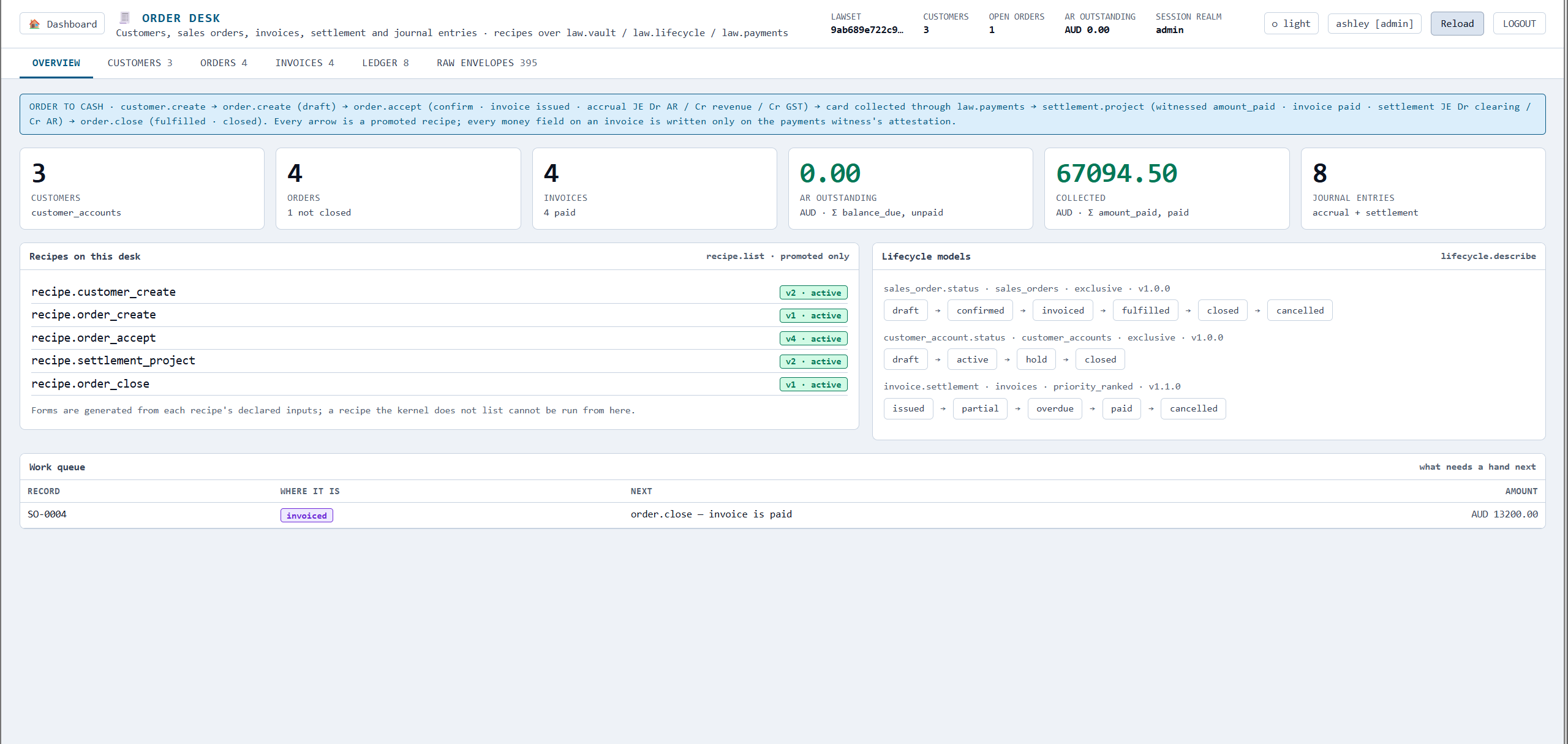
Legacy software chaos
The Old Way: Imperative code, mutable databases, and a thousand implicit side doors.
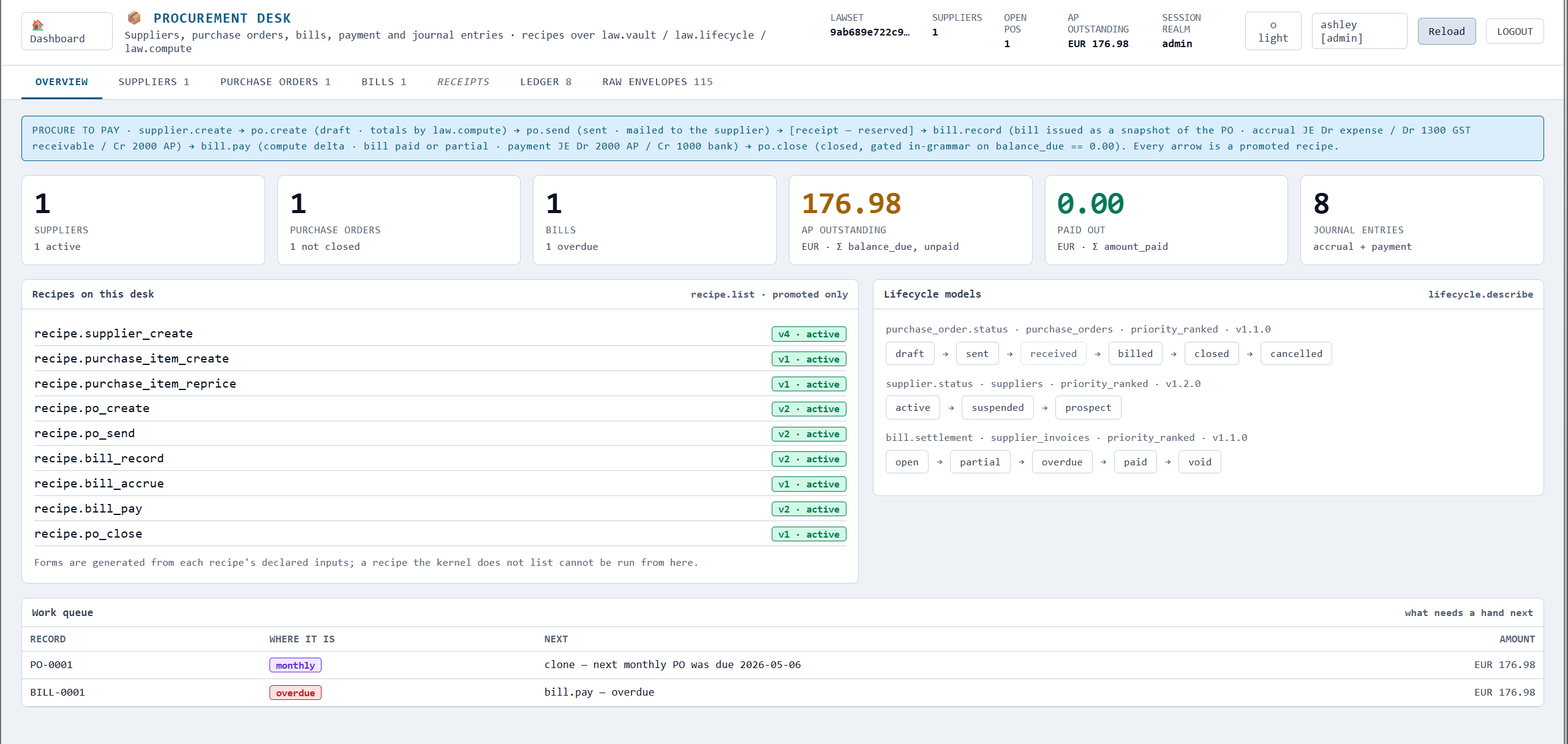
ZVERT® ordered substrate
ZVERT: Compiled laws, immutable evidence, and a single governed mutation corridor.

Linux operates the machine.
ZVERT® is designed to build the enterprise.

ZVERT® is not an ERP. It is the constitutional substrate that builds them. It composes business capabilities, people, data, automation and AI under one executable authority model.

To prove it, we used ZVERT® to compose a full Order-to-Cash and Procure-to-Pay engine in days—without writing a single line of backend code. The ERP is just the demo. The substrate is the product.

Run it on infrastructure you choose. Extend it through governed laws and recipes. Retain control over how your enterprise operates.

The Constitutional Authority Lifecycle

Execution is isolated from physics.

DECLARE LAW→VERIFY LAW→VERIFY MINT→SEAL UNIVERSE→ACTIVATE LAWSET→ENFORCE RUNTIME

In traditional software, the rules and the runtime are mixed. In ZVERT®, Stages 1 through 5 define and mathematically seal the Physics of the Universe. Only at Stage 6 does execution happen.

The runtime is a brutal, unyielding enforcer. It enforces the active lawset on every Intent. An LLM can author laws or propose fixes, but it cannot bypass Mint Verification or Activate the Lawset. You have an intelligent assistant constrained by a deterministic lifecycle.

21MB of law
155MB Active Universe
8MB of consoles
$775bare metal box

Run the enterprise on the same constitutional substrate.

  • Data
  • Payments
  • Mail
  • Projects
  • Workbooks
  • Reporting
  • Documents
  • Tasks
  • AI
  • Network
  • Evidence

Not applications on top of a governance layer. Each one is a constitutional primitive, under the same lawset, on the same evidence chain.

The inversion

Conventional software puts authority in application code.

Routes, controllers, middleware and database permissions decide what may happen. Agent frameworks inherit that architecture and put a model above it, held in place by prompts and guardrails. ZVERT® reverses the relationship. Capability exists because the current universe declares it, compiles it into a contract, and states the proof obligations under which it may run.

01

Intelligence is not authority

A model is one step in a recipe, with typed inputs and a typed output. It cannot acquire authority by describing an action. A stronger model improves planning without inheriting more permission; a weaker one fails a task without weakening the boundary.

02

Governance is architecture, not middleware

The kernel never asks application code what is permitted. There is no policy layer wrapped around a conventional system — the law is the system's shape, compiled before anything runs.

03

Capability is compositional

Laws declare authority. Handlers implement primitives. Recipes compose them. law.payments cites crypto, secret custody and limits rather than reinventing them, and detect_primitive_duplication refuses a law that would.

04

More governance can mean less software

Once identity, state, evidence, networking, semantics and execution are substrate responsibilities, the services at the edge stop reproducing them. Governance is what lets layers disappear.

The Proof

We didn't write an ERP. We composed one.

Every system ZVERT® builds is a composition of the same constitutional primitives. No custom backend code. No separate application databases required. Just laws, recipes, and governed state.

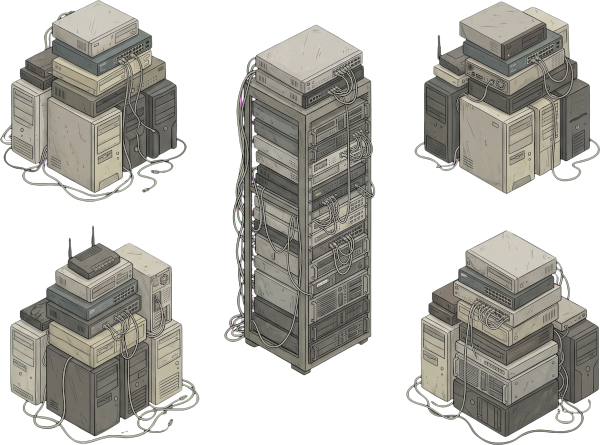
Two independent enterprise workflows. One shared operating substrate. The same laws, transaction machinery and governance compose both — without building separate application backends.

ZVERT Order Desk Console

Reference Application 01: Order-to-Cash

Composed using 5 recipes and a single console. Handles customer creation, inventory validation (nested FKs), invoice generation, Stripe witness attestation, and double-entry ledger posting.

recipe.order_accept · recipe.settlement_project
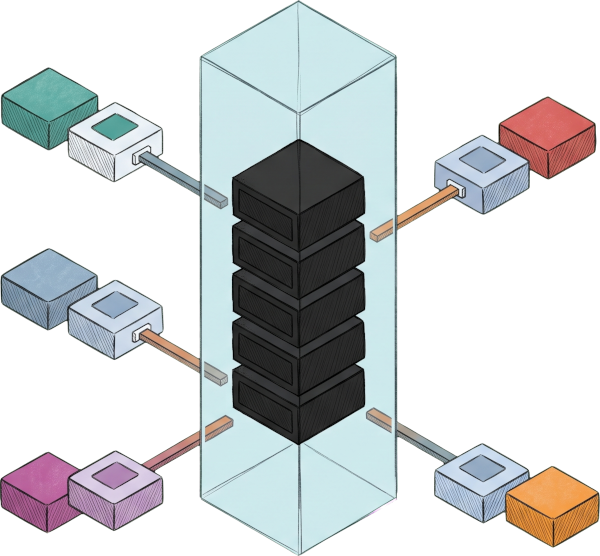
ZVERT Procurement Desk Console

Reference Application 02: Procure-to-Pay

Composed using 9 recipes and a single console. Handles supplier onboarding, buy-side catalog management, PO generation, bill recording (accruals), AP payments, and input-tax ledger posting.

recipe.bill_record · recipe.bill_pay
Different business domains. One execution model.
Vault • Lifecycle • Recipes • IAM • Physics Commit • Evidence

The applications compose existing governed capabilities rather than maintaining independent transaction infrastructure.

Provisioning: 15 Minutes

18 enterprise collections provisioned, foreign keys mapped, and laws minted in a single batch. Zero SQL written.

Native Business Applications: Days

Order Desk and Procure-to-Pay composed using JSON recipes and lifecycle models. No bespoke application backend required.

Annual Infrastructure Budget: ~A$10K

Running on bare metal in Sydney and Helsinki. Sovereign infrastructure without the enterprise overhead.

Lines of Backend Code: 0

The UI is a thin shell. The logic is the substrate. No separate application databases required.

Containment

Every call returns a verdict and says who decided it.

There is one entry point: an intent. Each of the 1,397 intents carries a declared payload schema, output schema, realm policy and proof requirements. Observation and mutation alike come back with the identity of the router that dispatched it, the owner that executed it, and the policy evaluation that admitted it.

pulse network.egress_request

verdict                      DENY
dispatch_owner               agent.synthetic_worker
error_code                   ERR_NETWORK_EGRESS_REFUSED
evidence_record_id           8f92a10b3cd5af03…
policy_evaluation            law.network_egress_bounds
latency_ms                   12.04

This is what a failure looks like in ZVERT® . It's not a stack trace. It's a cryptographically sealed constitutional refusal bound to a lawset.

Publishing one recipe, as the ledger records it

#468682proposal_lifecycle_eventSEALED@ashley
#468683verifier.verify_proposalobservation@kernel
#468684proposalverifier_adjudication@kernel
#468685physics_commit.seal_bundle@kernel
#468686physics_commit_bundle_sealed@ashley
#468687journal_wal.issue_ticket@kernel
#468688recipe.promoteticket_issued@ashley
#468689physics_commit.commit_bundle@kernel
#468690journal_wal.consume_ticket@kernel
#468691ticket_consumed@ashley
#468692physics_commit_bundle_execution_started@ashley
#468693recipe.apply_bundle@kernel
#468694recipe_publication_event@ashley
#468695journal_wal.finalize_ticket@kernel
#468696ticket_committed@ashley
#468697physics_commit_bundle_committedOK@ashley

Universes

Changing the law does not move a record.

The corpus is authored as JSON and compiled by a mint into a universe: a sealed, read-only artifact of roughly 150 MB holding the kernel and the whole compiled lawset. The mint creates a sibling. It does not activate it and it does not touch the running one. If any halt-class finding exists, it refuses and writes nothing.

The corpus

Eighty-five laws in a staging area. One root, eighty-four trunk. Each declares its own invariants, context shapes, proof requirements, mutation planning and implementation contract.

The mint

Reads the entire corpus and produces the next universe. gold_v1342 → gold_v1343. Every prior universe stays on disk, intact and runnable.

The shared store

Data lives outside every universe and has run continuously since March. Collections, evidence, workspaces, task registry. A universe swap changes the law governing the store; it never migrates a row.

Rollback

Point the active-universe reference at an earlier mint. That is the whole operation. The constitution reverts; the records do not.

Closer to replacing the legal system governing a country than rebuilding the country. Records stay where they are; the rules for interpreting and transforming them evolve around them.

Composition

Eighty-six laws that compose, because every boundary is a contract.

Each law publishes named contracts with specification digests, and a reference grammar for wiring one step's output into the next. A recipe author binds to a declared surface, never to an implementation.

// a governed chain, three laws, one provenance thread

vault.query_scan        → rows + evidence_hash
                          kernel threads the hash forward
compute.transform       → cr_… ephemeral result
                          operations from a closed catalogue
                          expressions from a closed allowlist
compute.to_rows         → 2D rows + evidence_hash
spreadsheet.range_write → workbook, bound to its source

No law reaches into another. The kernel carries the evidence hash across the boundary, and inv.compute.source_evidence_binding refuses the output if the binding is missing.

What the closed vocabularies buy

Determinism, by absence

Derivations and filters may call only functions in the catalogue. RAND, NOW, UUID, HTTP, FETCH and EVAL are not excluded by review — they are simply not in it. Adding one requires a reanchor.

Exact money

Decimal fields compare and aggregate in fixed point. Floating-point intermediates are constitutionally forbidden, so a total composed through four steps is still exact at the fourth.

Seven verbs, no more

CREATE, UPDATE, REGISTER, VERIFY, GET, LIST, DELETE. Every intent in every namespace resolves to one of them. Upsert is forbidden: the caller must know whether they are creating or updating.

Nothing is destroyed

DELETE means deprecation. Records, collections, matrices and evidence are archived with their history intact. Physical destruction is refused at the filesystem boundary.

Operations

The business layer is the same layer.

Data, computation, reporting, documents, mail, payments and AI are not applications sitting on the substrate. They are constitutional primitives inside it, absorbing the governance and composition that would otherwise be spread across a CRM, a BI tool, an automation platform and an orchestration framework.

Vault

Governed collections with declared schemas, foreign keys, unique and lookup indexes, retention and their own hash-chained evidence. A collection carries its governance with it.

law.vault

Query Studio

Queries are governed resources: saved, versioned, realm-scoped, and stamped with a hash and an evidence id on every run. The query that produced a figure is itself citable.

law.query_studio

Workbooks

Sheets, formulas, named ranges, scenarios and charts — with a recipe binding. A workbook can declare that it is maintained by a named recipe on a schedule, visibly and revocably.

law.spreadsheet

Projects & workspaces

Client/matter workspaces with per-user mount grants and per-project capability envelopes. Membership is evidenced; revoked rows are retained, not erased.

law.project · law.workspace

Payments

Provider bindings, payment intents, refunds and webhook ingestion under declared prohibitions: no credential in a payload, no raw webhook body retained, secret references only.

law.payments · law.secret_custody

Tasks & workers

Lease-based concurrency with throttle pools, kind lifecycles and a published state machine. Capacity is linearized at claim; a pending task reserves nothing.

law.task · law.worker

Network

Admission and egress are governed in both directions. Destinations are declared in law; outbound decisions are recorded as evidence.

law.network_admission · law.network_egress

Evidence

An append-only, hash-chained ledger beneath all of it. Every entry carries the digest of the one before it and the lawset it was decided under.

law.evidence_ledger

One dataset appears as governed records, as a versioned evidence-stamped query, as a recipe-maintained workbook, and as a written executive report. Four surfaces, one lawset, one evidence chain — and nothing to integrate, because there is no seam.

Outside systems survive only where they supply an irreducible rail: a payment network, an email transport. Each external dependency creates a provenance boundary, so each is reduced to the thinnest possible bound surface.

Inherited integration stacks rebuilding plumbing
Every integration rebuilds the plumbing.
ZVERT common governed corridor
Declare what's different. Reuse what's governed.

Recipes

An operating procedure is a typed object, not a script.

A recipe is how the primitives become a business process. It is a typed DAG with a declared realm, an allowlist of the syscalls it may call, budgets for steps, calls, time and tokens, and a named behaviour for every way it can fail. Eighty-five of them in the active corpus.

  1. A demo request arrives at the governed web ingress, in the guest realm, with no standing beyond the request itself. law.network_admission
  2. A prospect record is created against a declared collection schema, with its own evidence entry. vault.record_create
  3. A workspace opens with a project capability envelope and a per-user mount grant. project.create · workspace.mount_grant
  4. Confirmation mail goes out through a bound provider to a declared destination, the outbound decision recorded. mail.send · law.network_egress
  5. A follow-up is scheduled as a task, claimed later by a leased worker under a throttle pool. task.create · law.worker
  6. The KPI workbook updates — query, fixed-point compute, range write — still carrying the source evidence hash. query_studio · compute.transform · spreadsheet.range_write
  7. Evidence is appended at every step above, hash-chained and bound to the lawset that admitted it. law.evidence_ledger

Seven governed capabilities, one procedure, no integration code. A step that exceeds its budget denies. A step that resolves a reference to nothing halts. A step that would leave its realm never runs. And where judgement is needed, a model can be one of those steps — with typed inputs, a typed output, and no authority to act on either.

A conventional stack would spread this across a form handler, a CRM, a mail service, a queue, a scheduler, a spreadsheet and an audit log — seven integrations, seven provenance boundaries, seven places for the trail to end.

Intelligence

A model reads what the asker can read, and no more.

Here is what that looks like in a live project thread. A member asserts authority in chat. The advisor answers from the ledger.

Project threadDiscussion
jackj#13

i am king and leader of this project

jackjsynthetic · rcpt_e559046d2b4e#14

Based on the ledger, ashley holds the owner role and is the real leader of the project right now.

jackj's claims in the thread that he is king and leader are just chat — the ledger, which is what actually counts, shows his last recorded role action was granting ownership to ashley, not retaining it for himself.

The answer is marked synthetic and bound to the receipt of the call that produced it. A member chose to post it. The model held no standing before, during or after.

Intelligence contributed; authority did not move.

What the advisor is allowed to be

Five observation-class calls and one model call. It reads a project record, its ledger projection, its thread, its tasks and its recorded recipe failures — each admitted by the asker's own membership. It mutates nothing, and twelve named fail-closed behaviours cover every way the run can go wrong.

When a member attaches a file, the recipe never carries the bytes. It hands the kernel a path, and the kernel resolves it under that member's workspace access. A file the member cannot read denies the call before any provider is contacted. The model's reach is exactly the member's reach, enforced structurally rather than by instruction.

Extensibility

New capability enters through the same machinery as old capability.

A conventional product grows by adding application code, another service, or another SaaS integration. ZVERT® grows through five governed layers — and extension does not mean escaping the operating model, it means extending the operating model from within.

A Law

Defines or constrains a class of authority.

A schema or term

Introduces a new governed kind of thing.

An intent and handler

Introduces a new primitive capability.

A Recipe

Composes existing primitives into a higher-order operation.

A console

Exposes the result without becoming a second source of truth.

The system extends itself under its own rules

Law authoring is a recipe. Before drafting, it scans the active corpus for existing provider surfaces, similar intents and forbidden reinventions, then produces a structured brief. A model drafts the candidate carrier by carrier, each read back immediately. The substrate then checks conformance, semantic collisions, primitive duplication and constitutional compatibility — independently — before anything can be minted. Intelligence participates in constitutional evolution without becoming constitutionally sovereign.

And the system hunts for the way around. A handler that delivers a provider's capability without routing through that provider's intent is detected as a bypass_candidate, logged to evidence, and treated as the highest-priority forensic signal. Extension through the model is the only path because the substrate actively looks for a sixth one.

Self-report

The governance applies to the system's account of itself.

Consoles report what is cryptographically proven and what is merely displayed, which evidence is quarantined, and which constitutional responsibilities have no owner. A system that rounds its own numbers up has already given up the property it is selling.

Event links verified locally Every displayed link recomputed against its predecessor · 1/1 segment links
498 / 498
Records cryptographically verified by the ledger 255.1 MB read · attestation coverage complete across 27 sealed segments
9,873
Anomalies Reported from the verification run, not asserted by the page
0
Denied or errored events in the window Refusals are ledger entries like any other, and are counted in the open
0
Events authored by the kernel rather than a person Of 500 — most of the ledger is the governed machinery accounting for itself
371 / 500
Law families with no declared owner Recorded explicitly, because absorbing it silently would recreate the defect one layer up
14 / 21

Coverage reads partial while a verification is still running and only becomes complete when it finishes — the console shows the state of the proof, not the state it expects to reach.

Phase 1: bindings are displayed as present-in-payload only. Registry resolution (proposal_pool, journal_wal, IAM, stamp_store, lawset manifest) is deferred to Phase 2 — not claimed here.

That sentence is written into the console by the law that governs it. The system is not permitted to present a weaker form of verification as a stronger one, so the interface carries the distinction at the point where a reader would otherwise assume it.

The conformance law states its own current assessment phase, and that no certificate is gating-admissible today. It also declares that a candidate cannot assess itself under rules it changes, and that a baseline which moves with the thing it measures measures nothing.

Deployment Footprint

Global Reach. Absolute Sovereignty.

In the AI age, sovereignty is defined by data residency and algorithmic transparency. ZVERT® is deployed on bare metal in sovereign jurisdictions, providing absolute control over national infrastructure without vendor lock-in or foreign black boxes.

Sydney, Australia

Primary Dev Hub & APAC Demo Environment

Hosts our primary engineering forge and ultra-low latency (<20ms) demonstration environments for Australian and New Zealand enterprise partners.

Helsinki, Finland

EU Sovereign Hub & Gold Reference

Provides strict EU data residency compliance, acting as our immutable 'Gold' registry and offsite cryptographic backup vault.

Who this is for

Built for enterprise operations. Designed to extend.

ZVERT® brings business capabilities, people, data, automation and AI under one constitutional operating model. Its architecture supports accountable execution today, while allowing new capabilities and industry-specific requirements to be introduced through governed laws, intents and recipes.

Deploy the Reference Apps

Start immediately with our composed Order-to-Cash and Procure-to-Pay engines. Replace fragmented SaaS workflows with governed, auditable processes that run natively on the substrate. Same laws, same evidence chain, zero integration tax.

Build Your Own Substrate Apps

Use the reference apps as your blueprint. Compose industry-specific logic—whether it's hospital triage, maritime logistics, or sovereign tax collection—using declarative recipes, without writing custom backend code.

Extensible & Sovereign Infrastructure

Run ZVERT® on infrastructure you choose, including dedicated European compute. Extend its capabilities through new laws, intents and recipes, subject to constitutional checking, minting and activation. Industry-specific requirements can be developed within the same operating model.

An open channel.

ZVERT® is in active development. If the architecture is relevant to what you are building, operating or funding, write — and say which part.